
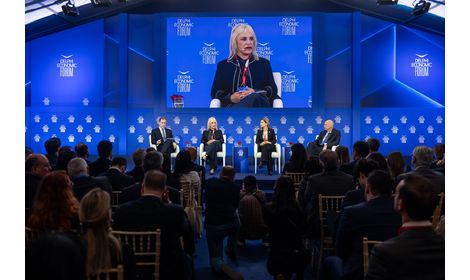
Julia Tsetis at Delphi Forum XI: “Sustainability is continuity and consistency – Our employees are our allies”
Sustainability as a core element of business strategy and investment in people was at the center of the remarks delivered by Julia Tsetis at the Delphi Economic Forum XI.
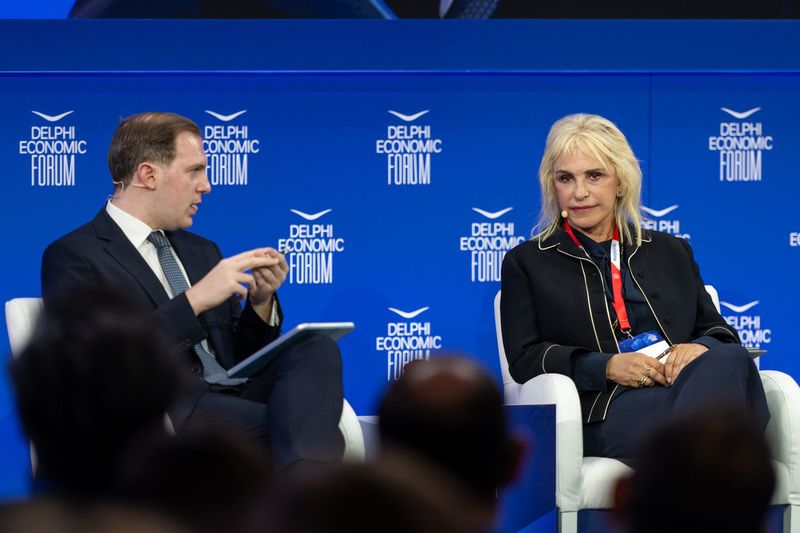
Approaching sustainability in business -as well as in the economy and society- not as a theoretical concept or an obligation, but as a business philosophy grounded in continuity, consistency, and investment in human capital, the President of OFET, Julia Tsetiw, spoke at Delphi Economic Forum XI during the panel discussion titled “Sustainability Ecosystem: The Answer for the Longevity of the Economy and Society” on Friday, April 24, 2026.
A central point of her intervention was that true sustainability is expressed through everyday practice: in the way businesses operate, in how they support their people, and in how they connect with society. She emphasized that companies must move beyond short-term performance criteria such as speed or profit maximization and instead focus on characteristics such as long-term presence, reliability, and resilience -especially in times of uncertainty and challenges. Using Aesop’s fable “The Hare and the Tortoise” she highlighted that persistence and consistency are what lead to long-term sustainable success.
Referring to sustainability in healthcare and life sciences, Julia Tsetiw underlined that good public health is the foundation of a sustainable society and economy. She pointed to the growing importance of the longevity economy and the role of major scientific developments in our time, such as regenerative medicine and epigenetic interventions. These developments, she noted, are creating new demands for highly specialized human capital. She stressed that the goal today is not only to live longer, but to live better and more functionally, leveraging the capabilities of science and technology.
She placed particular emphasis on the human factor, describing employees as indispensable partners in any sustainability strategy. She highlighted the importance of inspiring and retaining talent, especially in demanding environments such as Greece, where brain drain remains a challenge, stressing the need to create competitive conditions and ensure state support. In this context, she identified the life sciences sector as both a present and future-oriented field, offering meaningful prospects while contributing to social progress.
“For me, sustainability is the way we think every day, the way we invest and innovate, but also the way we inspire young people to stay in our country”, she noted.
At the same time, she emphasized the importance of continuity and consistency in sustainability policies and strategies, pointing out that lessons from past crises -such as disruptions in the supply chain- require coordinated and long-term responses.
Referring to technological developments, she highlighted the transformative role of artificial intelligence, particularly in accelerating research and innovation. As an example, she noted the reduction in development time for new product formulas, which -with the use of AI- can decrease from four or five years to just eight months. She emphasized that while AI can significantly reduce development time, it should be viewed as a tool to support employees rather than replace human knowledge and creativity. Values such as ethics, commitment, and human consciousness, she stressed, remain irreplaceable.
“Employees are our allies. Mindset, commitment, and dedication are values that artificial intelligence cannot acquire”, she stated.
Julia Tsetis also argued that the development and application of artificial intelligence must be accompanied by clear rules and ethical principles, as it is a constantly evolving field that raises complex issues.
In closing, she linked sustainability with resilience, stability and values-driven leadership. She emphasized that sustainable business models require a stable environment and strategic foresight, especially during periods of geopolitical challenges and supply chain disruptions. As she noted, sustainability, competitiveness, and profitability are not conflicting goals but interconnected pillars when businesses operate based on ethical principles and a strong human-centric approach.
Also participating in the panel discussion were Alexandra Palli, Chair CSR Hellas, and Andreas A. Papandreou, Professor of Environmental Economics at NKUA. The panel was moderated by journalist-news anchor Star Channel, George Evgenidis.